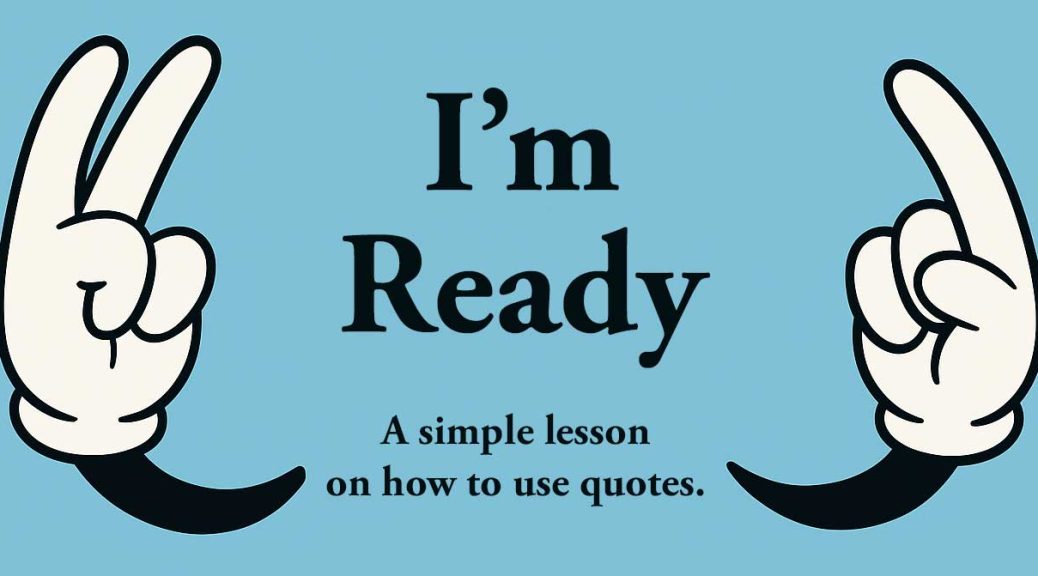
Using Nested Quotation Marks: Love your Dialogue
Nested Quotation Marks – What are they?
This “lesson” originated from my attempt to explain nested quotes or proper punctuation use to one of my clients. This isn’t easy, sometimes. In fact, I confused myself. Until I thought of what quotes do. They hold, or hug, our words. When we speak, the Big Hug, double quotes are used, encasing all of our words, including any nested quotes.
However, when repeating quotes from other sources, there is a rule to distinguish the nested quote from that of the speaker.
Let’s start with our two characters: Billy and Sally. Billy is in his bedroom, and Sally is waiting downstairs in the living room. If Sally wants to “quote” what Billy said—that is a nested quotation.
Nested Quotes are like hugs.
They embrace what people say.
Example:
Let’s consider a fictional dialogue: “a conversation, especially in a literary or dramatic context, or a formal exchange of ideas”
If YOU are talking, the punctuation goes inside the quotes. Punctuation marks include periods, exclamation marks, parentheses, commas, and question marks.
“I’m ready.”
“Can we go now?”
“That was awesome!”-OR-
Billy said, “I’m ready.”
Billy said, “Can we go now?”
Billy said, “That was awesome!”
Simple, right?
 Hugs Within Hugs
 Hugs Within Hugs
Think of quotation marks as hugs. With a nested quotation, it is a hug within a hug. Now, let’s look at a sentence where YOU would hug someone else’s words.
The key is
HUG!
Let’s say that Billy yelled from his bedroom, but Sally, who is in another room, couldn’t exactly hear him. Sally wants to ask her mother to confirm what she thinks she heard.
Situation:
- Sally is in the living room with Mom.
- Billy yells something from his room.
- Sally can’t hear him.
- She turns to her mom, asking what Billy said:
“Did Billy say, ‘I’m ready?’”
Note that Sally’s words are HUGGED using double quote marks, while Billy’s words are HUGGED using single quote marks.
In other words: Nested Quotation Marks.
Let’s break this down
Think of double quotes as BIG HUGS. They are usually from the speaker. And single quotes are SMALL HUGS, what someone else said.
Sally says: “Did Billy say, _____ ” (Sally is speaking / hugging her words)
Billy says: “I’m ready.” (Billy is speaking / hugging his words)
NOW, you want to wrap Billy’s statement in a SMALL HUG (single quotes) and add it to Sally’s question. (fill in the blank)
If you just added Billy’s words to Sally’s, you would have:
“Did Billy say, I’m ready?”
That is ALMOST right. This statement implies that Billy said Sally is ready. We need to clarify that Billy was saying the HE was ready.
Remember the formula:
BIG + small hug + HUG.
You need to wrap Billy’s words in a SMALL HUG using single quotes. Doing this lets us know that Sally is repeating what Billy said.
The correct answer is:
“Did Billy say, ‘I’m ready’ ”
NOW, add the punctuation. In this case it is a question mark. (?)
Final Sentence: A hug within a hug.
Sally said, “Did Billy say, ‘I’m ready?’ ”
You just created a small hug within a big hug.
This is called a nested quotation — when one person’s words are quoted (nested) inside someone else’s.
A Quick Note:
In American English, we use double quotes first (“ ”) and single quotes inside (‘ ’) — a hug inside a hug!
In British English, it’s often the opposite: they use single quotes first, and double quotes inside.
So in the UK, the same sentence might look like this:
‘Did Billy say, “I’m ready?” ’
And, in the U.S., you use:
“Did Billy say, ‘I’m ready?’ ”
Conclusion:
 Conclusion:
So the next time you’re writing dialogue, remember: nested quotation marks are like hugs! Use double quotes to hug what someone says, and when you’re quoting someone inside someone else’s dialogue, add a smaller hug with single quotes. Whether you’re writing a story, asking a question, or quoting a quote, you’ll know precisely how to HUG your words.
AND, Punctuation (in fiction) always goes INSIDE the HUG.
NOTE:
This post is based on the Chicago Manual of Style, for fiction and nonfiction works.
This is not for Associated Press Style (AP), which is used in newspapers, magazines, and most US news outlets.
In short:
-
Chicago Manual of Style = precise, traditional, consistent (great for books and fiction)
-
AP Style = practical, punchy, flexible (great for fast-moving media)
You May Also Like
Want to Learn More?
Here are the official sources for deeper reading.
-
Chicago Manual of Style Online
www.chicagomanualofstyle.org -
AP Stylebook (Associated Press)
www.apstylebook.com
UPDATED: July 1, 2025. Corrected proper placement for punctuation to inside all quotes for fiction.